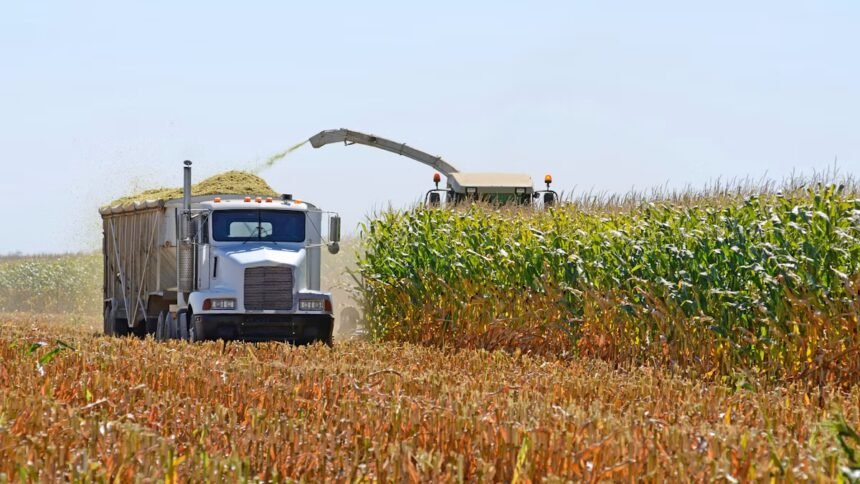
Dyed diesel, weight limit relief granted for Nebraska ag haulers
Nebraska Gov. Jim Pillen on Sept. 24 signed two executive orders providing regulatory relief to agricultural haulers in the state. Both orders are in effect for 90 days.
Pillen also sent a letter to President Donald Trump requesting federal intervention through a temporary 90-day pause on U.S. diesel exports to foreign countries, which Pillen said would allow domestic diesel reserves to rebuild, lowering costs for consumers and helping producers navigate harvest season without severe financial strain.
The President publicly suggested such an export pause last week, yet later cast some doubt on whether the administration would take that route to potentially boost diesel inventories and put downward pressure on prices, according to recent reporting.
[Related: Is a real diesel shortage brewing? Analysts assess risk]
Under Nebraska Gov. Pillen’s first executive order, highway-registered vehicles are permitted to hold, sell, or use untaxed, dyed diesel fuel without facing state fines or penalties. Additionally, diesel taxes paid while transporting Nebraska’s seasonally produced products and livestock on state roads are eligible for a refund by filing Form 84AG with the Nebraska Department of Revenue.
To address transportation pressures facing producers, Pillen also signed a second executive order providing weight limit relief for seasonal crop transport. Vehicles transporting seasonally produced products and livestock can operate up to 25% over legal gross and axle group weight limits without purchasing additional permits or paying associated fees.
“Our farmers and ranchers are the backbone of our state,” said Pillen. “It’s critical that I do everything in my power to make sure they are supported, especially during this season where they are working day in and day out to get the crops out of the ground.”
[Related: Alabama stops checking for dyed diesel]
Montana adopts federal HOS fuel-haulers waiver for intrastate drivers
Montana Gov. Greg Gianforte has issued an executive order adopting federal regulations issued by the Federal Motor Carrier Safety Administration to waive certain hours-of-service requirements for truck drivers transporting gasoline and diesel fuel.
Under the executive order, the Montana Department of Transportation’s Motor Carrier Services Division will apply the same HOS terms to intrastate gasoline and diesel haulers that FMCSA already applies to interstate carriers. The order does not apply to any other type of cargo and leaves all other state and federal safety requirements in place.
The order takes effect immediately and remains in effect through Dec. 16, matching the duration of the federal waiver, unless extended, rescinded, or otherwise modified.
“Montana families, farmers, and businesses depend on a steady, reliable supply of gasoline and diesel,” Gianforte said. “This order makes sure our in-state fuel haulers can operate under the same rules as interstate drivers, so fuel keeps moving without unnecessary red tape.”
FMCSA issued a waiver Sept. 16 to give interstate truck drivers additional flexibility under federal HOS rules in response to anticipated fuel demand increases and ongoing global supply chain pressures. The federal waiver specifically invited states to extend the same relief to drivers operating within their borders.
[Related: FMCSA waives HOS regs for gas, diesel haulers]
New study shows wide variation in diesel quality metrics
Howes Products tested 15 winterized No. 2 diesel fuel samples collected from retail pump dispensers across the United States and Canada. The results reveal that diesel sold under the same pump label can vary significantly in several performance-related characteristics.
Samples were collected at various locations in Wisconsin, Tennessee, Kentucky, North Dakota, Minnesota, Texas, Oklahoma, Iowa, Nevada, Rhode Island and Canada.
Samples were tested as received and analyzed for six properties that directly impact diesel performance and reliability:
- Cloud Point
- Cold Filter Plugging Point (CFPP)
- Flash Point
- Biodiesel Content
- Water Content
- High Frequency Reciprocating Rig (HFRR) Lubricity
To ensure samples reflected real-world fueling conditions, the company worked with a group of independent Howes customers, partners, and industry influencers rather than company personnel. Participants included Kate Whiting, owner-operator of the iconic 1973 Kenworth W900 “Cherry Pie”; “Trucker Josh” Giesbrecht, a well-known trucking Youtuber who regularly travels between the United States and Canada; and well-known country music artist and professional driver Tony Justice. (All have been recognized as members of Howes’ Hall of Fame.)
The testing revealed considerable variation across all six measurements.
Among the findings:
- Cloud point ranged from +14°F to -38°F, a 52-degree difference, highlighting how significantly cold-flow properties can vary from location to location.
- CFPP, the critical plugging point measure, ranged from +9°F to -38°F, a 47-degree spread across the samples, indicating a wide variance at which fuel can really begin to restrict filter flow.
- Flash point varied from 124.4°F to 142.9°F, a 14.9% variation across samples.
- Biodiesel content ranged from 0.2% to 6.1% by volume, a huge variation in bio concentration across the samples, with those above 5% lacking the B5 label for blends above 5%.
- Water content ranged from 13.2 parts-per-million to 56.2 ppm.
- HFRR lubricity, a lower-is-better measure of the ability of fuel to minimize friction, ranged from 184 to 476 microns — a substantial difference in wear scar diameter, a key indicator of fuel lubrication performance.
“Some people think of pump diesel as a single, consistent product,” said Rob Howes II, President, Howes Products. “While many know that’s not true, there are still misconceptions regarding how different diesel can be even from pump to pump in the same area. What this testing demonstrates is that diesel fuel can vary considerably from one fueling location to another — and even from one fill-up to the next. Those differences can influence cold-weather performance, fuel system protection, and overall vehicle operation.”
Researchers noted that part of the variation in cold-weather performance was expected because several samples had been winterized using #1 ultra-low sulfur diesel (ULSD), a common practice in colder climates. However, even after accounting for winter blending, significant differences remained in lubricity, flash point, water content, and biodiesel concentration.
One of the study’s most notable findings involved lubricity. Two northern fuel samples exhibited nearly identical cold-flow characteristics and flash points, yet their HFRR lubricity results differed dramatically — 476 microns versus 252 microns. Because a lower HFRR wear scar indicates better lubricity, the results suggest that fuels appearing nearly identical in routine screening can provide substantially different levels of fuel system wear protection.
[Related: Fuel treatments increasingly part of owner-ops’ PM routines]
The study found noticeable variation among samples collected by the same driver during routine travel, indicating that fuel chemistry can change from stop to stop rather than simply by geographic region.
Water content, while important for corrosion prevention and cold-weather reliability, did not correspond directly with the poorest lubricity results in this sample set. Likewise, biodiesel was detected in every sample tested, ranging from 0.2% to 6.1%, illustrating that low-level biodiesel blends are now a common part of the diesel fuel landscape. None of the pumps were identified as containing bio blends, further proof diesel equipment operators and owners can never be certain what’s coming out of the pump.
“The most important takeaway from this study is that diesel fuel should not be viewed as a single, uniform product simply because it carries the same pump label,” said Jed Talbot, Chemist at Howes Products. “Fuel composition is influenced by factors such as seasonal blending, biodiesel content, refinery practices, additive packages, storage, and distribution. Our results showed that fuels with very similar cold-flow characteristics could still perform very differently in critical areas like lubricity. That’s why understanding fuel variability and taking steps to protect against it is more important today than ever before.”
The complete report includes detailed laboratory data, analysis of each fuel property, and discussion of how naturally occurring variations in commercially available diesel fuel can impact equipment performance.
Key to the findings is that diesel additives, like the complete line from Howes Products, the company said, not only make a difference. When used consistently, they can prevent harm to vital engine components and generally help today’s ultra-low-sulfur diesel perform better.
Read more about the study at this link, and keep tuned for this week’s Overdrive Radio podcast going into more depth with Howes Chemist Jed Talbot.
[Related: Diesel Laptops founder Tyler Robertson: New Howes Hall of Fame member]