Gunshots erupted from solid ground towards a boat that ferried Panamanian soldier Albis Fajardo and his team during a counter-drug mission along the country’s Pacific coastline.
The team attempted to return fire as they pulled back from a harrowing effort to target a cartel leader. Fajardo, then early into his military career, felt his adrenaline surge as he realized the team had been unsuccessful: A bullet had torn through the flesh of his friend.
Over a decade later, with the early autumn sun sinking over Panamanian base Aeronaval Cristóbal Colón, the 47-year-old, now a first sergeant, recounted the ordeal. His friend survived, but the horror changed Fajardo’s life.
The brush with death, he said, fueled him to learn as much as he could, militarily, and eventually led him to become an instructor at the U.S. Army’s Jungle Operations Training Course in Panama.
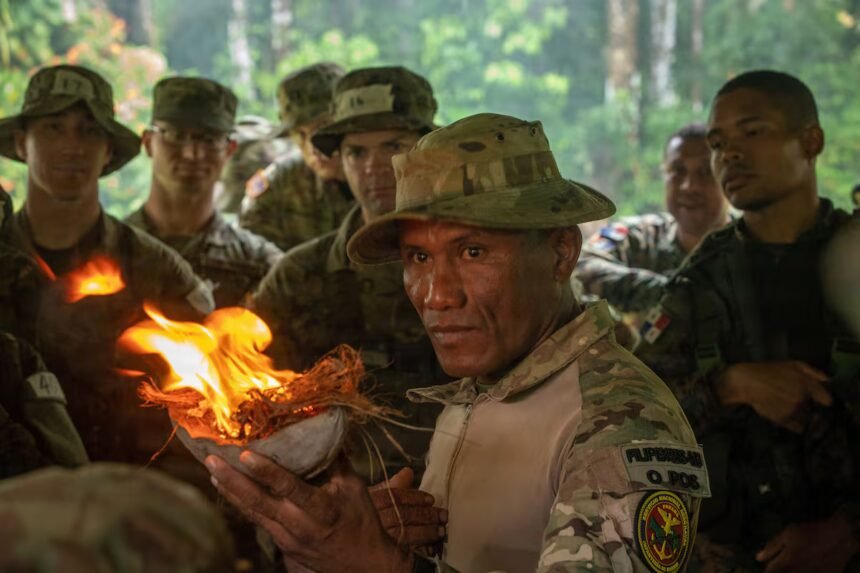
The class, offered for decades in the Central American nation before it was shuttered in 1999, has resumed in partnership between U.S. and Panamanian forces, with Panamanian service members teaching and attending the 18-day course.
As Panama’s troops have trained, lived — and in some cases, fought — in such environments, they are largely seen by U.S. personnel as the ultimate masters of the terrain.
Lt. Col. Andrew Eagen, who heads the U.S. Jungle Operations Training Center in Panama, said that as U.S. forces developed the course, they became quickly attuned to the deft tactics their Panamanian counterparts had developed for survival.
“They are the experts of this environment. We will never catch up,” he told Military Times in a mosquito-riddled interview at the jungle school.
“This does not exist in the continental United States,” he said, gesturing to the lush canopy, which was twinkling with the day’s last glimmers of sun and abuzz with the evening hum of jungle creatures. “We do not have an exposure to it. They do, and they have incredible techniques and an incredible level of comfort that the average American [does not].”
Fajardo is one of nine Panamanian instructors — from three branches of the country’s armed forces — who teach at the reestablished school.
The instructors assist in some parts of the course, but lead in areas where students learn about jungle survival, Eagen said.

In addition to the leading group, more than 10 Panamanian service members attended the course in which Military Times took part, according to Eagen.
Throughout each exercise, Panamanian troops sat interspersed with U.S. personnel and were placed in squads with a Spanish-speaking U.S. participant for course assignments.
Though the language barrier admittedly made some tactical movements difficult, U.S. personnel seemingly learned just from observing their Panamanian counterparts.
During one practical exercise, one squad had to hide in the jungle, cover their tracks to erase any disturbance to the foliage, and position themselves so they would be alerted to any incoming intruders.
The other squad’s job was to hunt down the hiding squad using tracking clues, the activity forming a tense game of tactical hide-and-seek.
The hunters ultimately won, thanks to one Panamanian squadmate who spotted a tiny vine that appeared slightly too parallel to the ground.
One rule of the jungle? Nothing is a straight line. The Panamanian student correctly identified the trailing plant, hovering inches above the muddy ground, as a hasty trip wire. Made using a vine and a piece of trash, it would have alerted the hiding squad to the hunters’ presence.
When the two groups gathered to discuss the interaction, the lanewalker found that the Panamanian student in the other squad had set up the tripwire; a particularly impressive development, considering a tripwire class was scheduled for later in the day.
During that class, an American instructor showed students how to create different forms of tripwires that could act as early warning systems. Some set off rattling cans. Others used fauna.
Before letting students practice, the instructor shared stories from Panamanian cadres who once operated in the Darién Gap, a roadless land bridge of brutally dense, remote jungle that spans 60-plus miles between Panama and Colombia and has been notoriously rife with human and drug trafficking.
Trip wires there are not historical relics of warfare from decades ago, the instructor said. Cartel members are using them now.
Several instructors, including Fajardo, have attended Panama’s own jungle school, called Panajungla.
Fajardo shook his head and shivered as he recounted the intense course in which participants were forced to survive on their own in the Teribe region of Panama’s Bocas del Toro province.
Students of the Panamanian course must shop at the “supermarket de la selva” — the jungle supermarket — to eat, using machetes to prepare or kill any nourishment they can find, Fajardo said.
Fajardo’s prized jungle delicacy is ñame, a tropical root vegetable similar to a yam. He also appreciates the taste of grubs, he said, which he likens to butter.
Tucked neatly into each Panamanian instructor’s backpack, razor-sharp machetes sat nestled in intricately carved leather coverings.
The U.S. Army teaches machete training in its jungle school, but some Panamanian instructors have attended a separate, more intensive course on using the long, daunting blade. It can clear brush, help prepare food, carve shelter and even help start a fire.
To Fajardo, it is the single most important tool for survival in the jungle. And with a smile, he jokingly referred to the machete as “mi esposa,” or my wife, in English.

To date, the U.S. Army is developing the course to dedicate at least 20 of its 120 spots to partner forces and at least 15 to Panamanians.
Though no other countries have sent soldiers yet, Eagen is confident that the school is close to having Colombian students join.
The U.S. has partnered with Colombia’s Lancero course, which is similar to Ranger School, and all three countries exchange information. Panama supports hosting Colombian forces, Eagen added, as “they have a direct relationship with the country.
“They have a lot of shared bilat right there at the Darién,” Eagen said, “so both Panamanian leaders and Colombian leaders want them to be first.”
Panama’s expertise in navigating such unforgiving terrain, meanwhile, has also prompted other countries, like Costa Rica and Brazil, to express interest in the course, Eagen said.
Other jungle courses worldwide have so far informed the new U.S. Army jungle school’s curriculum, and Eagen said the Army is designing a scenario construct for the school using threat characteristics seen by Panamanian service members.
And while Panamanian forces often confront small-team drug trafficking operations attempting to establish supply lines, Eagen was clear that the Army endeavored to replicate a potential combat environment, not the country’s security situation.
“That is not the premise of us being in Panama,” he said. “We try to make sure there are clear boundaries of understanding for the students that this is about the skills required of the environment, not about the situation in Panama.”
Though public sentiment between the countries has ebbed and flowed in the decades that followed Panama’s 1994 formal abolishment of its standing army — several years after a U.S. military invasion ousted military dictator Manuel Noriega — those tensions were absent from interactions Military Times observed among the service members during the course.
Eagen said the U.S. is mindful of the pride Panamanians take in their nation’s sovereignty. The Army, he added, has been purposeful in approaching the course’s renewed partnership with an emphasis on learning from — rather than simply teaching — its Panamanian counterparts.
Eve Sampson is a reporter and former Army officer. She has covered conflict across the world, writing for The New York Times, The Washington Post and The Associated Press.