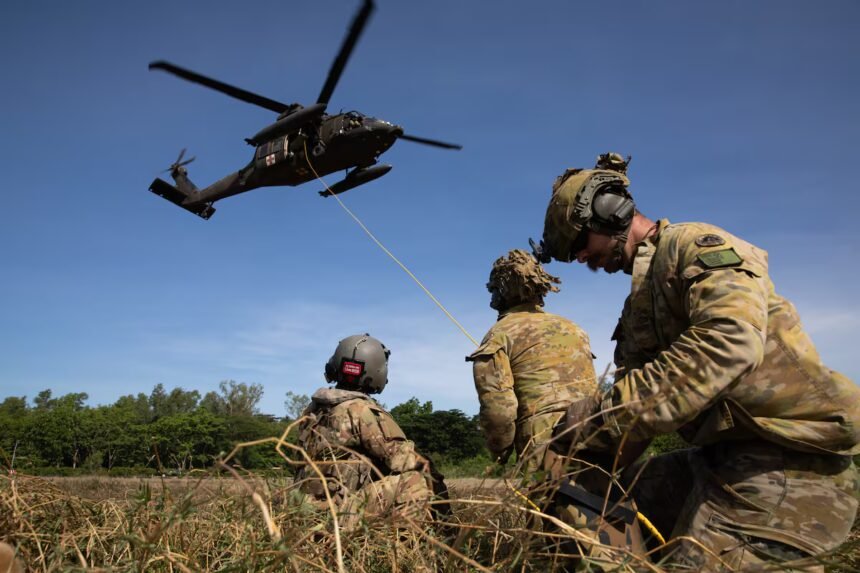
U.S. Army combat medical teams are experimenting with ways to prolong care in preparation for a possible fight in the Indo-Pacific theater, where vast distances and limited evacuation platforms affect a patient’s timely access to surgical care.
A fight in the Indo-Pacific would look different from past wars, such as Iraq and Afghanistan, making maintaining the “Golden Hour” standard difficult.
Instead of requiring medical care and evacuation to a surgical facility to occur within 60 minutes of a traumatic combat injury, the 18th Theater Medical Command, based at Fort Shafter, Hawaii, is rethinking the term to mean bringing advanced care to the point of injury.
The “tyranny of distance” in the region makes implementing the Golden Hour challenging since it accounts for over 50% of the world’s surface, 18th TMC Maj. Gen. E. Darrin Cox told Military Times on Monday during AUSA 2026.
“In the past, what [the Golden Hour] has meant is getting someone from the battlefield to a [medical] facility in that 60 minutes, so here in the Pacific, that may not be possible,” Cox said. “So what we’re talking about when we say Golden Hour is the pathophysiology of injury and bringing care to that patient in that time before pathology becomes deranged.”
As autonomous systems become increasingly relevant in militaries across the globe, the command is experimenting with ways it can assist patients with prolonged care at the point of injury, while keeping in mind the possibility of an attack.
Blood Storage and Distribution
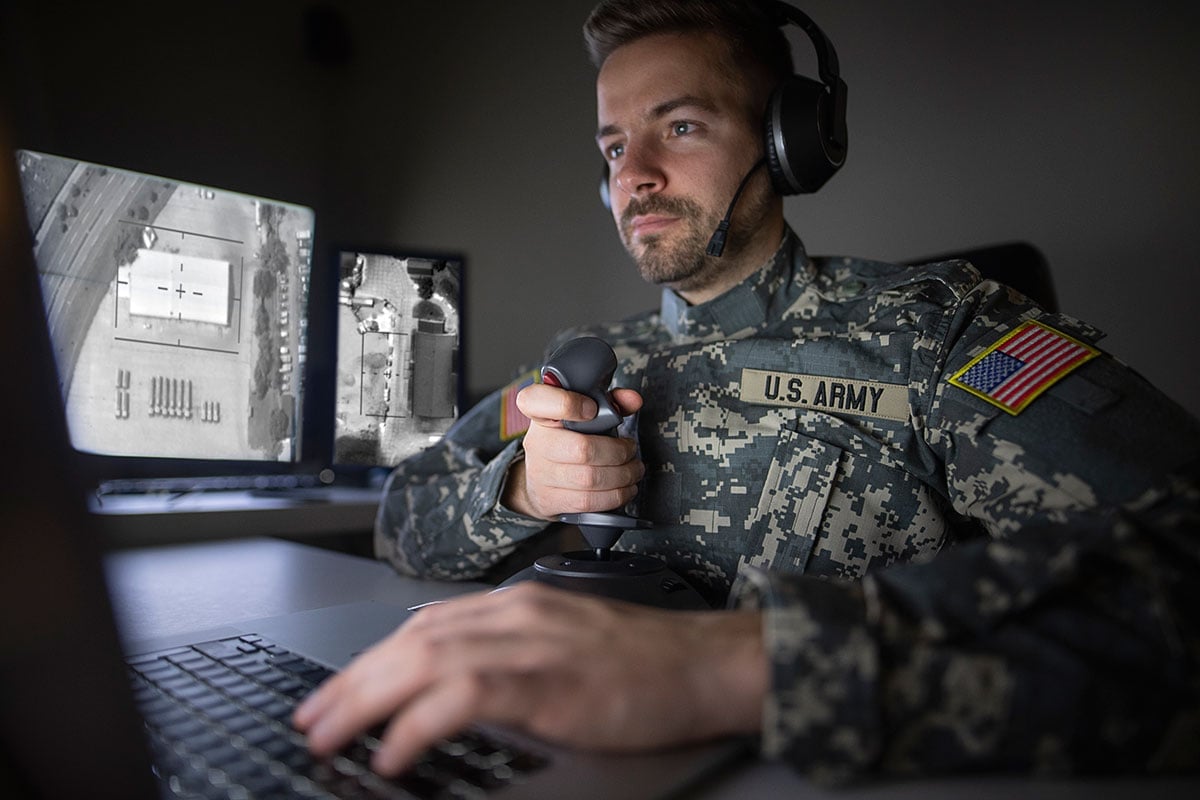
Even though warfare and medical care are both “human endeavors,” Cox said, autonomous systems are a part of the future. The systems can help deliver care through managing a patient’s vital signs, triaging patients, delivering blood or monitoring a patient so a provider on the ground can take care of others.
“We’re experimenting with autonomous delivery of blood and other Class A medical supplies,” Cox said. “They’re experimenting in Ukraine with autonomous evacuation of injured folks off the battlefield, so there’s a lot of work in that area.”
“Not everything in Ukraine is directly applicable to the maritime environment you find yourself in the Pacific, but we take what we observe, we learn those lessons, and then we try to apply it to the operating environment that we’re in,” he continued.
Alongside experimenting with autonomous systems, the 18th TMC is working with joint partners and allies to ensure access to blood distribution facilities, storing it west of the International Date Line.
“We were able to successfully bring blood from Japan to Australia last year during the Talisman Saber exercise,” Cox said. “That demonstrates developing those networks where we can move blood from potential storage locations to the points of need as different operations would surge.”
In critically injured trauma patients, blood and its components are necessary at the point of injury, Cox said, whether it’s blood provided by other countries for American use or stored ahead of time in a facility.
The best option is fresh whole blood, but that requires collection on scene, which has a limited supply, and refrigerated fresh blood has a limited lifespan. Another option is frozen products, both blood and plasma, but they need to be thawed with specialized equipment.
Cox highlighted that many partners in the Pacific, like the Philippines, are developing their own armed forces blood program where they have a stockpile of blood in military hospitals and accept donations. America is looking to have blood-sharing agreements with some joint partners, like Australia and Japan, which have a similar testing protocol to America’s and allow for the U.S. to use blood procured locally on U.S. casualties.
“We’re also with our partners in the Philippines,” 18th Command Sgt. Maj. Jennifer Francis told Military Times. “We ensure that we share what we’re doing in the field, so that we can enhance their own capability. So we’ve made huge strides there in the Philippines.”
Training on New Concepts
Ensuring that the combat medics are familiar with these concepts and innovations ahead of a conflict takes training on “anything and everything” related to the options, she said.
The Army has multiple “echelons of care,” but it all begins with basic self-care training and the more advanced Combat Lifesaver training before some reach the combat medic level.
“Once you get to tactical combat casualty care, that’s a little bit more robust,” Francis said. “They have the basic application of tourniquet[s], and then going through some of the head-to-toe trauma.”
In the Indo-Pacific theater, the overall medical care is not significantly different, unlike the environment, prompting the 18th TMC to continue to innovate through technology and training to keep trust with soldiers.
The 18th utilizes an 8th Forward Resuscitative and Surgical Detachment, or FRSD, which is a 20-person team that can execute surgery in the theater, Cox said, and the command is tinkering with different configurations of tents versus fixed mobile containers that can be taken on or off an Army watercraft, land or underground.
At the May 2026 Land Forces of the Pacific Symposium and Exposition in Hawaii, the 8th FRSD demonstrated a care simulation on a cut suit which modeled a surgical unit aboard a vessel.
Boats or ships should transport patients because evacuating by air en masse would be less likely, Army medics told Military Times at the event. The team began using autonomous small multipurpose equipment transports, or SMETs, uncrewed, eight-wheeled robotic combat vehicles guided with a remote control, to carry patients.
Cristina Stassis is a reporter covering stories surrounding the defense industry, national security, military/veteran affairs and more. She previously worked as an editorial fellow for Defense News in 2024 where she assisted the newsroom in breaking news across Sightline Media Group.