Wisconsin-headquartered Kevin Campbell’s operating with a distinct advantage over most owner-operators and fleets trucking-wide. With fuel cost soaring in some months this year above 75 cents/mile for the average trucker, according to ATBS, as of early this month Campbell’s hauled with a fuel outlay of just 46 cents/mile, beating the average owner-op for most months of 2025 as well, when fuel hovered around 50 cents/mile by ATBS’ accounting.
How on earth is Campbell managing a $2.90/gal. average price at the pump when for most of the year the average has been over $5?
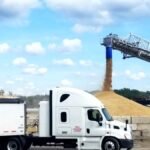
He’s not buying from one of those diesel thieves on the black market, that’s sure. Attentive readers will have noted the module behind his sleeper, not exactly a headache rack there, as it were, and empty space along the frame rail behind his steps.
The sleeper shown above is his daily driver today, but he owns another 2016 Freightliner day cab also outfitted with Cummins’ ISX 12G.
A chief benefit of CNG use is price stability.
“It’s so much easier to run a business when you know your operating costs are going to be stable,” Campbell said. When he bought his first CNG unit in 2019, his fuel cost averaged roughly $2.60/gal., beating diesel at that time, too. In recent years CNG’s fetched $2.80 or so, he said, rising 10 cents/gal this year, as noted.
Diesel nearly doubled.
The difference? “Natural gas is an American product,” said Campbell. “And when you take all the people that have their hands in diesel making profit, from the oil to the refiners, to the distributors, to the retailers, natural gas just doesn’t have that many steps along the way. And it really makes a difference.”
Aside from the compression for transport, he noted, “it’s the same stuff that heats most people’s homes in the United States. … It’s affordable, and it’s clean” compared to diesel.
Owner-operator and past small fleet owner John Harris is headquartered in Southwestern Kansas, where Campbell and his wife lived for a time after Campbell’s exit from the banking world and headfirst dive into trucking almost two decades ago. Campbell considers Harris a trucking mentor, in some ways, giving him the inspiration to move into hopper freight, for one, key to Campbell’s business today.
Harris tried to warn him off CNG, given the 400-hp rating of the ISX 12G, yet Campbell had seen it work for fellow bulk mail carriers he knew. At once, Campbell admits “this 12-liter motor isn’t great in the mountains” with big climbs to 6,000 feet or higher, he said, combined weight maxed at 80,000 lbs. Yet “as long as I’m not in the mountains, I’m all right.”
John Harris gives Campbell kudos for daring creativity, a hallmark of his ongoing success. “He’s a very good businessman,” Harris said, illustrating the two-way street of trucking mentorship. “He gave me a lot of good ideas” over the years gone by. “I’ve been in business myself since 2003, learning from the school of hard knocks,” primarily.
Harris may have helped Kevin Campbell a “little with this or that,” he added, but the Wisconsin-based CNG-powered owner-op gets all the credit he deserves as far as Harris is concerned. “He made his own thing,” he said.
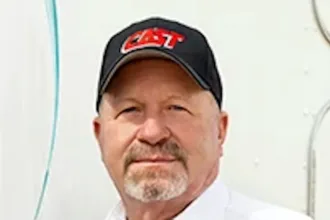
Owner-operator Kevin Campbell is Overdrive‘s October Trucker of the Month, the last monthly honoree in the push toward the 2026 Trucker of the Year award.
 Owner-operator Kevin Campbell is the last of 2026’s Trucker of the Month, joining fellow competitors for Overdrive‘s 2026 Trucker of the Year award.
Hotshot RV transport to bulk CNG-powered hopper
Owner-operator Kevin Campbell’s authority is registered with the Team 1 RV, LLC, business name, a relic of his start trucking as second career after 28 years in banking in Michigan, where he and his wife raised their five children, “mostly,” he said.
 Owner-operator Kevin Campbell
After near three decades in banking, children mostly grown, his wife took on teaching work in Garden City, Kansas, where the pair still have a second home. Campbell “worked for the railroad for a few years,” deciding fairly quickly it wasn’t for him, he said.
Around that same time, he began to notice hotshot RV pullers utilizing pickups and RV toter haul-and-tow straight-truck units. He put that Class B to work. For his first two years trucking, two drivers worked for him, too and they’d move three RVs outbound, then tote their own equipment back with one of their powered units pulling a long-enough flat-deck trailer, keeping costs low as possible when loaded return trips weren’t possible.
“It was a pretty economical operation,” he said, setting the stage for later moves. With his authority as Team 1 RV, “I was all in,” he added.
[Related: Hotshot trucking retains its fundamental allure for owner-operators]
He would spend the seven years that followed in federal contracting, running equipment for the Pentagon’s shippers and then mail for the Postal Service. “All contract basis,” he said, and “steady work.”
It wasn’t his first tour through running a business himself. While he an employee in the banking world, he dabbled in a side construction business. “And on the banking side,” he said, “a lot of my clients were business owners or builders and developers. So I had to review business tax returns constantly” as part of the job.
He was well set to mind the numbers, today logging fuel purchases and miles, and setting maintenance minders, with the handy Fuelly app on his phone, records of all manner of expenses (hotels, other vehicles in addition to his current one) then tied into his accounting system.
“I use it for all the hotels. I use it for all my vehicles,” personal too. he said. “It’s cost me, I think, five bucks a year for the app. I mean, it’s the best five bucks a year I spend.”
[Related: Diesel rising again: New tools for MPG-investment ROI, IFTA tracking]
Federal contracting took him up to five trucks at the height of the business’s size, and doing that postal work during the 2010s he met a member of the prominent Wisconsin-headquartered Sheehy family of mail haulers, active in the National Star Route Mail Contractors Association.
The Sheehys got in early with CNG-powered trucks.
“That fascinated me,” Campbell said. “I watched it and looked around at it,” and as conditions deteriorated around trucking in 2019, an election upcoming that Campbell felt he could see was going to change the party at the top, “I bought my first CNG truck.”
With COVID in 2020, that administration change, two rounds of war-inspired diesel spikes from without and within, and cost inflation all around since, “it’s been the best move I’ve ever made,” he said. CNG costs have risen, too, as shown above, but in some states incentives deliver deals.
Anytime he’s in Topeka, Kansas, for instance, “I can still get CNG from the Kansas gas service for $1.08,” he said.
As trucking companies struggled through the third year of a freight downturn in 2025, Campbell’s number showed a profit margin of nearly 52% net biz income on strong revenues, well above the average 42% for ATBS client owner-operators.
[Related: Owner-op income near record high already, early in upcycle: ATBS]
In short, excellent results in what was very tough year for so many around trucking.
Diversity in ag, industrial hopper freight
Campbell owns a couple of hopper trailers — dual compartment, bottom unload — and at this point no others. Occasionally he might need a flatbed, and he’s “got a buddy we rent one from,” he said. “I’ve got some direct customers I deal with, a couple brokers,” and “customers that we sell grain and commodities to direct as well,” handling the transportation themselves after making the connection between producer and end user buyers.
Nick Halaschak, a Cater Logistics manager, noted Campbell’s a go-to for industrial granules under the company’s contract with a Wausau-based shipper. “He gets everything delivered on time,” Halaschak said, “certainly nothing bad to say about him.”
Cater owns eight company trucks and 30-40 trailers themselves, all primarily end dumps but with roughly 20% of the freight necessitating a hopper like Campbell’s.
“I started working here a year and a half ago,” Halaschak noted, and among outside carriers working with the company’s brokerage, Campbell’s been a consistent presence that entire time, his relationship with the company dating back well before Halaschak’s time there.
“He’s great with communication,” Halaschak said, thinking of Campbell as “one of these old-school guys who call you on the phone. A real stand-up guy, always picks up the phone no matter what. If I need something last minute — if I needed a load tomorrow, I’d call him and he’d be there” if humanly possible.
[Related: Getting closer to the customer: Freight relationships beyond broker boards]
In addition to that direct freight on the ag side, Campbell’s got a go-to broker source in the PT Brokers company and longtime hopper transport logistics specialist Katelyn Spaulding. “Most every time I call him,” she noted of Kevin Campbell, he answers. If not, “he’ll get right back to me” with availability for one or another of the company’s Midwest farm loads of grain product. “He always seems like he’s in a good mood, chipper mood, always seems happy and doesn’t get frustrated” when obstacles arise. “He just goes with the flow.”
Is his CNG-powered Freightliner a unicorn amongst her stable of owner-operators and some dedicated carriers? “I’d never heard of that until he told me a while ago about it,” Spaulding said.
Halaschak, too. “I would say that is unique” in his experience, he said.
“Most of the people you talk to about these gas trucks, they just look at you like you’re crazy,” Campbell said. Like: this guy’s nuts. He just tells them: “It’s all about the bank account,” and not just fuel-cost dividends accrued. “Through the longevity of time we’re learning the maintenance on these motors is minimal.”
There’s exhaust-gas recirculation in the power system, but a cleaner burn cuts out the big soot problems that plague diesel exhaust.
“They run really clean,” Campbell said. “You don’t get the dirt in the oil, no contaminants in there.”
[Related: Shell rolls out StarShip 3.0 with Cummins X15 natural gas]
 Campbell’s 2016 Freightliner sleeper fueling up recently.
Minding maintenance for the uninitiated does make for a big “learning curve, no doubt,” nonetheless, he said. CNG “pumps at 3,600 psi into the tanks. And then you have a regulator on the truck that brings it down to operating pressure.” At once, “it’s really pretty simple.”
Two filters in the fuel system need service. “One I service twice a week” by draining oil separated from the gas. That filter acts “like a water separator in a diesel,” he added, to guard against oil in the gas coming from the compressing company/utility where you’re buying.
Another filter on the tanks he services annually. Tanks require inspection by “qualified gas personnel” every three years to ensure integrity, he said, and “it’s free.”
The Cummins ISX 12G itself Campbell’s got on an oil-change interval of 18K miles, and “the oil barely gets dirty between changes,” he said. The engine “doesn’t use any oil between changes.”
He bought the sleeper-Cascadia he operates today with 190,000 miles on it, he noted. It’s pushing a million today at 965K and some change. “I put a rear main seal on it and an oil pressure sensor, and that’s it,” he said of the extent of necessary repairs, in addition to adjusting overheads three times, at an interval of 200K miles.
He’s “curious now to see how far it’s going to go,” he said, truly happy with performance to date.
[Related: ‘Long-haul with natural gas’ possible: Tour Cummins’ X15N]
 View of Cambell’s rig from behind the cab
He’ll be looking at a tank replacement required at 15 years of age. “I’ve got no concern about safety of them,” contrary to some drivers’ worries over gas explosiveness. “How many times on the news have you heard about a gas truck blowing up?”
When it happens, and it certainly has, he’s seen “usually it’s improper maintenance” that’s the culprit. He doesn’t worry about his own procedure on that front. A “nice thing with gas under compression is if you have a leak, you smell it in a hurry.”
He’s experienced it when a fuel filter wasn’t quite as tight as needed to the gasket — sensors beeping alerted him in addition to his nose, and “I checked it,” tightened, and “it was fine. You have to trust your systems” and “be diligent” about inspections.
 Team 1 RV’s hauling “footprint’s mostly in the Midwest,” Campbell noted, though he’s gone as far West as the Rockies, occasionally into New Mexico, and as far East as down to Florida in the winter. CNG availability hasn’t been a huge problem excepting in the Dakotas, a blank spot on his Upper Midwest map.
IFTA reporting occurs the same way it does for other owner-operators, though incentives to use CNG from some states mean tax liabilities are reduced. Plenty states do levy “the exact same as diesel,” he said.
Cold-start problems? “You don’t have that with these trucks,” according to Campbell, a benefit for his Midwest winter operation. He’s never had the truck towed, though occasionally he might divert from the shortest route 40-50 miles to get to a CNG filling station. He stays out of the Dakotas if he can.
[Related: CNG-powered truck explodes in Los Angeles]
The future: ‘Don’t be afraid to think outside the box’
With Cummins’ recent-years introduction of its X15N, Campbell’s bullish on long-haul natural-gas power with a step-up in performance over the 12Gs he’s run.
“I truly believe this is the future of trucking,” he said. Fueling infrastructure could use improvement, he noted, and though government incentives may have really gotten the ball rolling for CNG, they’re “not necessary” at this point.
Return-on-investment pencils out, as he sees it, and for owner-operators who might learn from his example, he stresses the good ol’ American ingenuity that got CNG-powered transport to where it is today.
“We put men on the moon,” he said, and “we’ve done a lot of great things in this country. Using our natural resources is one of the greatest things we can do.”
He advises any aspiring or new owner-operator this way: “Don’t be afraid to think outside the box, to take a chance, to do things a little bit differently.”
That’s how he’s approached his decade-plus trucking thus far. “It’s been a great learning curve, but also a lot of fun,” he said. “You never know how great it’s going to be until you try.”
While he’s tried retirement of sorts, back when he was 45 and fresh off employ at the bank, he decided to keep plugging away at building business, at his own pace. “I’m going to try to make a difference here in the last decades of my life,” he said, his family now with one remaining child still under their umbrella at 20 years old and nearly flying on his own.
He’s on the family health-insurance policy, his wife’s school employer’s plan, though they’ve carried individual insurance-exchange policies in past.
New truck orders with the X15N he said are out of his reach, for now — he’s tried, hopeful for an upgrade that might take him more solidly into the next years. “They won’t sell me a truck, a new truck with an X15 natural gas, because I’m not a big-enough fleet,” he said. “They’re all on allocation.”
Yet not to be deterred, what he can get is the power plant itself. “So we’re going to actually dive into the realm of repowering … gliders or previous diesel trucks with X15 CNG motors” via a consulting business in partnership with a builder, Campbell said.
“I’ve got a shop set up that had built gliders years back when you could still get a glider,” he said, “and they’ve expressed some interest in a partnership,” a venture he was hopeful to be able to detail in the new year.
“We need a cash cow for the trucking industry,” said Campbell. Looking over the last several years, “honestly I don’t know how some guys have survived it the last few years. The cost of everything is way out of control — everybody wants to squeeze you on a per-mile basis everywhere we go.”
Debt’s escalating, revenue’s dropping.
“There’s a real problem. Everybody’s gotten used to running on these skinny margins,” he added.
He’s hopeful he can be an inspiration to those who would fatten those margins considerably.
“The big companies getting their products shipped aren’t worried about the profitability of small trucking companies,” he said. Truckers themselves are the “only people who are going to look out for the trucking industry.”
Keep an eye out for Campbell in 2027.
[Related: How owner-ops dodge shady brokers, ensuring freight’s paid when due]
Hear all 2026 contenders’ stories in their own words via the Overdrive Radio playlist below.