While any owner-operator well knows the importance of vehicle maintenance and pre-trip inspections, many might be surprised by what the Federal Motor Carrier Safety Regulations actually require. For this Trucking Law installment, we’ll be running through six myths to get to the reality of what really matters during a pre- or post-trip inspection, and what exactly law enforcement agents look out for when it comes to annual inspections, according to Paul Taylor, a managing partner of the Truckers Justice Center who has represented truck drivers in various matters for more than 25 years.
MYTH 1: A driver must prepare a pre-trip inspection report before he/she drives the truck.
The reality is more nuanced. A carrier may well require a driver pre-trip inspection report, but isn’t required to do so by law.
For post-trip reports, on the other hand, 49 C.F.R. 396.11 mandates that a motor carrier require its drivers to prepare a written report “at the completion of each day’s work on each vehicle that the driver operates.”
This post-trip report must list defects in parts and accessories identified in the regulation, such as tires and windshield wipers, and the report must be submitted to the carrier when defects are found. If there are no defects, no report is required.
The one exception to the post-trip report requirement is in the case of intermodal equipment provided by an intermodal equipment provider.
MYTH 2: A driver must perform a pre-trip inspection.
Technically, this is not true. 49 CFR 392.7 simply requires a driver to be quote unquote “satisfied” that certain parts and accessories identified in the regulation are “in good working order” before driving. Similarly, 396.13 requires that a driver be satisfied that any truck he or she operates is safe to drive. The Federal Motor Carrier Safety Administration guidance says a driver may rely on a co-driver’s inspection or a safety lane inspection for assurance that a truck is safe to operate.
MYTH 3: A driver must record at least 15 minutes on his log for a pre-trip inspection.
This is a whopper of a tale told by truck stop lawyers. 49 C.F.R. 395.8 requires all time recorded on a log to be accurate. If you log five minutes for an inspection that actually took 15 minutes to perform, then you are effectively guilty of log falsification — which can be a felony. Of course, a thorough pre-trip inspection may in fact take 15 minutes, but no particular length of time is required by law. The only requirement, as noted, is that the driver be satisfied that the truck and trailer are in good working order.
MYTH 4: A violation-free Level 1 roadside inspection is a substitute for an annual inspection.
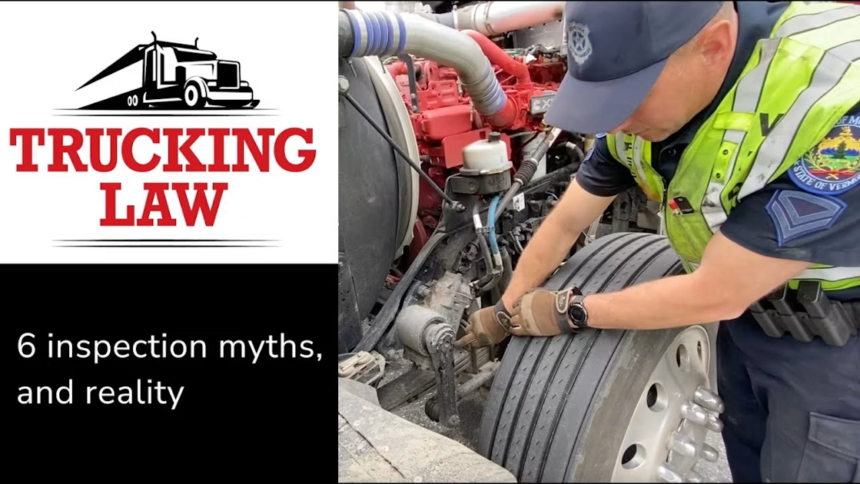
A Level 1 inspection, which a Vermont DMV enforcement agent is demonstrating in this video, may get drivers out of being inspected again in the near future, but it isn’t the same as the required annual inspection.
49 CFR 396.17 requires a carrier to perform, or have performed by another party, as the case may be, detailed quote unquote “periodic inspections” addressing parts and accessories named in the regulation. A Level 1 roadside inspection once did in fact satisfy this requirement, but in 2016, FMCSA eliminated a roadside inspection as a substitute for the annual periodic inspection. However, the agency does allow inspections by state officials in a relative few states and Canadian provinces that have mandatory inspection programs that satisfy federal requirements to substitute for the annual inspection.
MYTH 5: An “annual” DOT inspection must be performed not less frequently than annually.
This is not exactly true. 49 C.F.R. 396.17 uses the “Periodic Inspection” heading, but the regulation itself also references quote unquote “annual inspection.” What’s required is that the “annual inspection” be performed “at least once during the preceding 12 months.” Thus, a periodic inspection performed in accordance with Appendix G on August 1, 2022, is good until August 31, 2023, because it was performed within the preceding 12 months. So at the very longest, the “annual” inspection legally might extend over almost 13 months.
MYTH 6: A carrier may not limit the amount of time a driver may take to perform a vehicle inspection.
This is not true. In the case of a pre-trip inspection, in a past case involving United Parcel Service, the U.S. Department of Labor has ruled that an employer may in fact impose reasonable inspection methods and reasonable time limitations on the inspection.