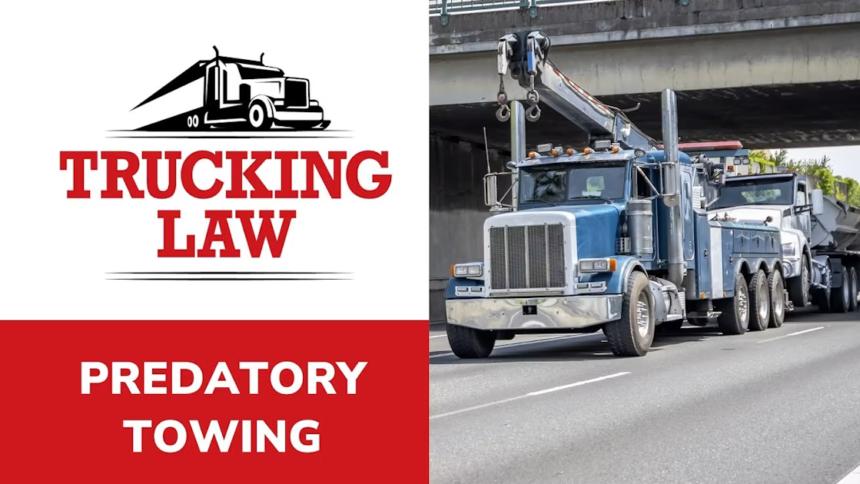
Speaker 1: Recent years have seen a well-documented rise of predatory practices around nonconsensual tows of heavy-duty trucks, whether police-ordered after a crash or parking-enforcement-type tows from a private lot. How does $200,000 for recovery of a single-vehicle crash sound? How about $7,000 just to move a tractor and trailer 16 miles. Worse yet: A 33-hour standoff with a wrecker holding a driver in their truck hostage on a private lot where the cost to park is just $5, and signs to that effect scant and obscured.
These are the towing horror stories regularly making headlines, and the pace has only increased. Predatory towing isn’t just inflation, it’s not just sensational headlines. It’s more than just a few bad apples, and it’s not going away anytime soon. Some say it’s a coordinated attack on trucking, on an industrial scale.
For big fleets, the threat mirrors that of nuclear verdicts. Legal and safety departments brace for an impact that could happen any time a driver gets behind the wheel.
For owner-operators, though, a $100,000 towing and recovery bill after even a not-at-fault accident can spell out a death sentence for a trucking career, maybe ruin life at home, too.
A recent report from the American Transportation Research Institute lays bare shocking statistics. 82% of carriers report being overcharged by towing companies. Another 82% say they’ve been hit with ridiculous extra fees to jack up the price.
The ATRI report provides a fantastic overview of the problem. Yet until the wider world acknowledges the grave realities, truckers need a resource. Overdrive Executive Editor Alex Lockie spoke to attorney Adam Brand, founder of Brand & Tapply, for this installment of our Trucking Law video series. Attorney Brand weighed in at length in the ATRI report and has more than 25 years of experience fighting predatory towing cases in court.
Brand said the “biggest mistake” carriers of all sizes make happens before the tow company even dispatches. It happens when the carrier picks their insurance.
Owner-operators and small fleets are incredibly exposed, vulnerable to the tow company, given the downtime that could occur after being disabled, towed and the equipment held hostage. Insurers can help guard against the bad actors, yet according to Brand, insurance companies are re-writing policies recognizing the predatory-tow risk. This can take the form of significant policy limits on how much they pay for towing and recovery. Brand sees some limits as low as just $5,000 to $10,000 dollars.
An insurer paying a policy’s $10,000 limit on an egregious $100,000 claim can simply “walk away” from the claim, leaving the carrier held hostage with no hope of an insurance adjuster’s thorough investigation.
Though it may cost you, get the right insurance and the predatory tow company becomes the insurer’s problem, too. Their investigatory muscle can be brought to bear to contain the damage.
Otherwise, buckle up for a grueling battle in court, where frankly the options look bleak. On average, carriers win about 50% of the invoice back in court, Brand said. So if a towing company invoices $100,000, and the owner-operator or small fleet thinks $10,000 represents a fair price, after a heap of legal fees and time in court, the carrier can probably expect a jury to order restitution of around $60,000.
But that’s only if the carrier treads carefully and documents everything starting the moment the tow is initiated. There’s plenty you can do on-scene and in the aftermath of a tow to protect yourself, meanwhile.
If you’re not fortunate to personally know a tower wherever you happen to be when the incident disables the truck, there are networks of towing companies that guarantee both their work and rates, to avoid egregious billing. Otherwise, you’ll be at the mercy of whoever’s on the police rotation.
Make note of what equipment the company brings to the scene. Make note of the number of staff, the number of companies, and how long each person and piece of equipment stays on-site. Lots of predatory towing invoices show evidence of bald-faced lies about how much equipment was used, or for how long.
Take pictures, video, or any other sturdy types of documentation.
After any word spoken or document exchanged with the towing company, send an email to put in writing the substance of the surrounding conversation. Documentation that holds up in court can’t just be diary entries, so try to get everything timestamped and in writing. For instance, if the towing company says on the phone they can’t talk now and will ask the boss later, send an email describing that interaction and stating your inquiry about the status of the recovery, and that your message is time-sensitive.
Some tow companies will try to make the job seem like a consensual tow when it’s not, but avoid signing any such paperwork.
Assignment of benefits, approval of rates, guarantees of payment — you’re not obligated to sign these, either, and attorneys recommend you don’t.
The devil truly lurks in the details. Adam Brand said he’s seen companies bill for overhead, as in invoicing a carrier for four headsets used by staff on-site, as if they’d discard the headsets fresh with each job. Sometimes, tow companies will attempt to bill for services they did not provide. For example, the fire department cleans up an environmental hazard, yet it appears on your bill from the tow company.
Look out, too, for subcontractors on the invoice, which predatory towers often apply a markup to. The ATRI report gives a good idea of what typical per-pound and hourly rates look like to help you audit the invoice.
If and when the tow company holds your equipment hostage, you’re essentially an annuity to the predator, which can charge hundreds of dollars per day for simply keeping your equipment in their possession, according to Brand. This can include the necessity of filing against a bond or what’s known as “paying under duress.”
That does mean paying up, but also making sure you’re preserving your rights to contest those charges. For that, it’s critical to make sure the payment clearly states it’s made under duress. If the tow company demands to be paid in cash, communicate in writing that it’s an unreasonable and unfair business practice and instead offer a certified check.
The demand for cash can be used as evidence of unfair business practice in court. Such evidence should be reported to the state’s attorney general, towing board, or other relevant bodies.
Some states, like Florida, allow companies to sell seized equipment to pay the bill. Brand said he’s seen cases where the equipment is sold at a less-than-fair auction for a pittance, such as a $50,000 truck purchased by the tow company itself for a mere $4,000, effectively a $46,000 net gain with resale.
If the insurer’s or your own efforts are unsuccessful in reducing an egregious bill, retain legal counsel and expect a months- or years-long legal saga. Yet armed with credible documentation as described, you stand your best chance of success.
Keep in mind, though: Trials are hard, they take a long time, and they’re expensive, too.
Also, unless a settlement can be reached, a jury will decide. The company that presented an egregious, predatory bill will likely dust themselves quite nicely for a court appearance, according to Brand. They’ll try to present themselves as a small-business person like you, a person that is a first responder and available 24/7, someone who frequently puts themselves in harm’s way and has to purchase expensive rotator and wrecker equipment in an uncertain business environment. There’s ample truth to that. Towing companies face a lot of the same challenges truckers face in terms of operational difficult and cost inflation.
Finally, documenting any breaches of local and/or state regulations committed by the company, like improper storage of vehicles or unfair business practices, can go a long way toward disrupting their narrative in court.
Learn much more about fighting back against egregious tow bills and practices via our step by step guide at the link on the screen. In that guide, too, find examples of state legislation aimed at reining in predatory practices and just how you can be an effective advocate with state and local lawmakers. Also there: links to the American Transportation Research Institute’s report around predatory nonconsensual tow practices, and attorney Adam Brand’s firm’s website.
More installments in Overdrive’s Trucking Law series are available via the Trucking Law section of OverdriveOnline.com.